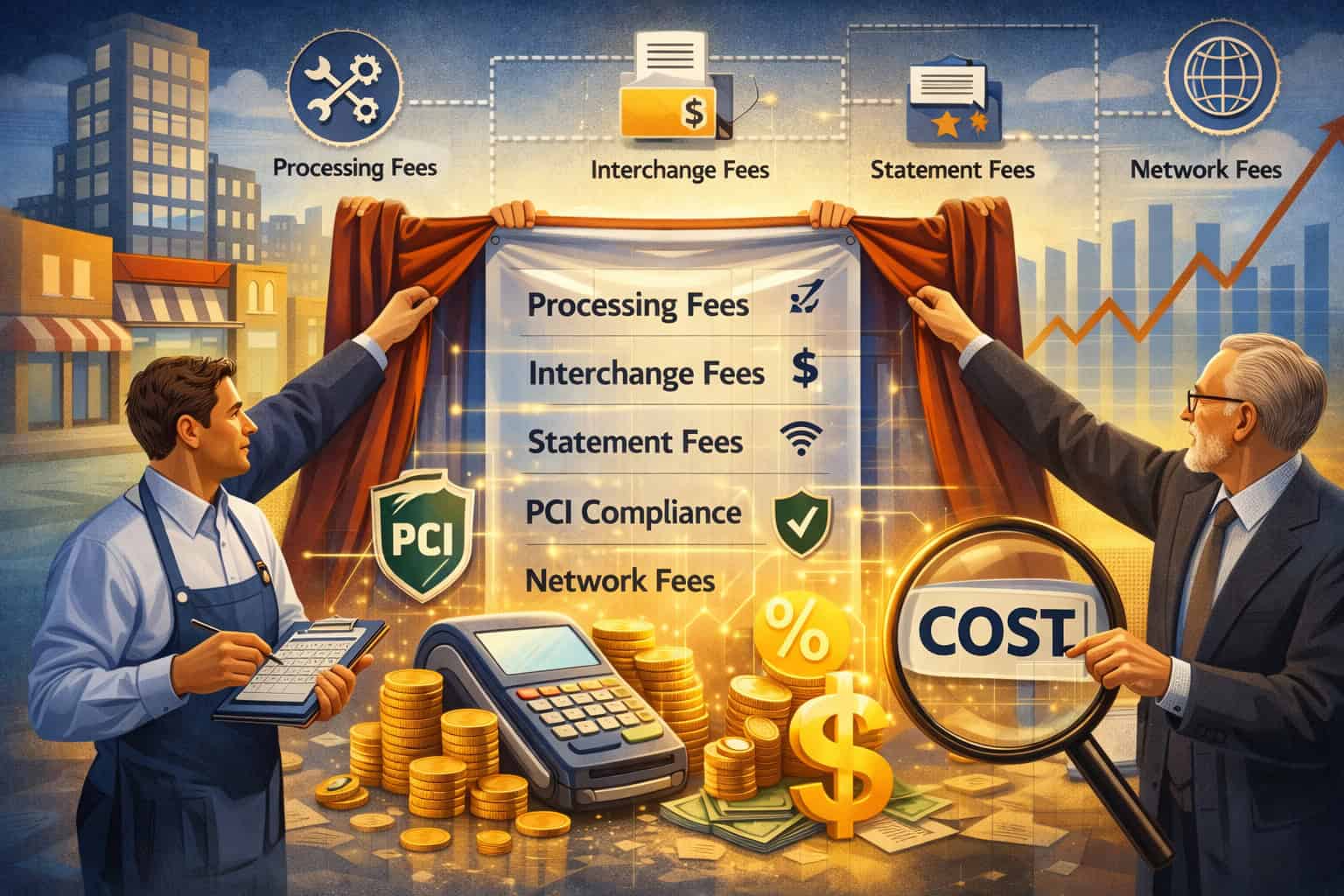
Cost transparency in merchant services is the difference between guessing what you pay to accept cards and knowing exactly what you pay, why you pay it, and what you can realistically lower. When cost transparency in merchant services is strong, your pricing is clear, your statement is understandable, and every fee has a name, a purpose, and a predictable trigger.
When cost transparency in merchant services is weak, you get vague bundles, shifting markups, “miscellaneous” lines, and surprise add-ons that make it hard to budget or compare providers.
At a practical level, cost transparency in merchant services matters because payment acceptance is a margin game. A few basis points here, a new “non-qualified” bucket there, or an avoidable monthly minimum can turn a profitable product line into a break-even one—especially for lower-ticket businesses.
Transparent pricing also improves decision-making: you can choose the right checkout method (tap, chip, keyed, online), adjust policies (refunds, tips, surcharging/discounting), and invest in fraud tools without being blindsided later.
Cost transparency in merchant services is also about accountability. A provider who can explain every line item is a provider you can negotiate with. A provider who can’t—or won’t—usually benefits from confusion.
Transparent merchant services pricing doesn’t always mean “cheapest,” but it does mean auditable—and auditable is where real savings and fewer disputes come from.
Finally, cost transparency in merchant services is becoming more important culturally and regulatorily. Broader enforcement against misleading fee practices is pushing industries toward clearer pricing disclosures, and businesses increasingly expect “all-in” clarity rather than fee fog.
(For example, the FTC’s Rule on Unfair or Deceptive Fees took effect May 12, 2025 for certain industries and reflects growing pressure for upfront price clarity.)
What “Cost Transparency” Really Means in Payment Processing

Cost transparency in merchant services means you can answer five questions without calling support:
- What is the base cost of the transaction?
- What portion is controlled by card brands/issuers vs. your provider?
- What triggers each extra fee?
- What can you change operationally to reduce costs?
- How do costs scale as you grow?
In card payments, not every cost is “set by your processor.” The total cost usually combines (a) underlying network/issuer components and (b) your provider’s markup and platform fees. The challenge is that statements often mix these together.
Cost transparency in merchant services improves when the statement separates underlying components from provider-controlled charges, and when your agreement clearly defines markup, pass-through items, and fee change rules.
True cost transparency in merchant services also includes timing transparency: when fees are assessed (daily discount vs. monthly billing), how refunds are treated, how chargebacks are billed, and whether certain fees are per-location, per-terminal, per MID, or per gateway.
It includes policy transparency: what happens if you change volume, add online payments, start shipping internationally, or introduce subscriptions.
Most importantly, cost transparency in merchant services is testable. If you can take a single transaction and reconcile it from authorization to settlement to funding—with the exact fees and rates attached—then you have transparency. If you cannot, you are operating in the dark, and “competitive rates” is just marketing.
The Full Cost Stack: Where Your Processing Dollars Go
Cost transparency in merchant services starts with understanding the “cost stack.” Your effective rate is the sum of multiple layers, and statements may show them as separate lines or as bundled pricing.
The bottom layer is card-issuer and network economics. For many transactions, a major component is interchange and network assessments, which vary by card type, acceptance method, and risk.
Debit can follow different rules than credit, and debit interchange is subject to specific regulations and standards in certain cases (for example, Regulation II / 12 CFR Part 235 is the framework tied to debit interchange standards and routing provisions).
The next layer is acquiring and processing: the acquirer/processor infrastructure that connects you to networks, manages settlement, and handles compliance programs, reporting, and risk monitoring.
Then come merchant-facing tools such as terminals, gateways, tokenization vaults, fraud tools, recurring billing engines, invoicing, and reporting dashboards. Finally, there are incident-driven costs like chargebacks, retrieval requests, disputes, fraud losses, and certain compliance penalties.
Cost transparency in merchant services means your provider is honest about which layer each fee belongs to. If something is a pass-through item from networks, it should be labeled and measurable. If it’s provider markup, it should be contractually defined. If it’s optional tooling, you should see the price and the value.
The payoff is control. Once you see the stack, you can choose whether savings should come from negotiating provider markup, optimizing acceptance methods, reducing keyed entry, improving fraud posture, shifting debit routing options where eligible, or cleaning up operational behaviors that trigger extra costs.
Interchange, Assessments, and Why Your “Rate” Isn’t One Number
Interchange is often the largest single component behind card acceptance costs, but cost transparency in merchant services requires one key mindset shift: interchange is not a single rate.
It is a schedule of categories that change based on how a transaction is run—card present vs. card not present, rewards vs. basic, business vs. consumer, debit vs. credit, and qualification factors like AVS, CVV, and settlement timing.
Assessments (sometimes called network fees) are additional charges tied to the card networks. They can include brand fees, data usage fees, or network program fees. These are usually smaller than interchange but can still matter at scale, and they can be especially confusing because they may appear as multiple micro-fees.
Strong cost transparency in merchant services means your statement (or reporting) can show interchange and assessments by category, not as a mystery bundle. The point is not to memorize every category; the point is to identify your “top cost drivers.”
If 60% of your volume falls into a more expensive bucket because you key transactions instead of dipping/tapping, transparency makes that visible—and fixable.
For merchants who want deeper benchmarking, the Federal Reserve Bank of Kansas City has published updates compiling interchange fee schedules and examples by category, which can help illustrate just how widely these costs vary.
Processor Markup, Platform Fees, and the Hidden Profit Centers
If interchange and assessments are the “base,” your provider’s markup is where negotiation and comparison matter most. Cost transparency in merchant services means you can clearly see:
- Per-transaction markup (e.g., a fixed cents amount)
- Percentage markup (basis points)
- Monthly account fees (statement, platform, gateway, reporting)
- Incidental fees (batch, AVS, tokenization, dispute handling)
- Equipment and software costs (terminal lease vs. purchase; POS licensing)
Here’s the hard truth: many pricing headaches come from provider-controlled fees, not interchange. A low advertised rate can be offset by a high monthly platform fee, inflated per-item charges, PCI “non-compliance” penalties, or bundles where the provider quietly increases margin.
Cost transparency in merchant services improves when you insist on two documents being clean and consistent: (1) a fee schedule that names every possible fee and (2) a statement that uses those same names. If the schedule says “Gateway Access: $X/month” but the statement says “Data Services: $Y,” transparency is already failing.
Also watch for “profit centers” disguised as convenience: “free terminal” offers, “rate lock” promises that exclude add-ons, and “cash discount program management” fees that quietly escalate. Transparent providers can still charge for value—support, uptime, risk tools—but the pricing should be stable, explicit, and tied to real services.
Merchant Pricing Models and How Transparency Changes in Each

Not all pricing models reveal costs equally. Cost transparency in merchant services depends heavily on which structure you’re on—and how the provider implements it.
The three common structures are interchange-plus, tiered, and flat rate. Interchange-plus is typically considered the most transparent because it separates the base cost (interchange + assessments) from the provider’s markup.
Tiered pricing groups many interchange categories into “qualified / mid-qualified / non-qualified” buckets, which can make comparison difficult because the buckets vary by provider. Flat-rate pricing charges a single (or small set of) rates, which can be easy to understand but less transparent about the underlying drivers.
Cost transparency in merchant services doesn’t automatically mean you must choose interchange-plus. A flat model can be transparent if it clearly defines what is included and what is extra (chargebacks, AVS, monthly fees, cross-border, premium cards).
Tiered pricing can be less transparent because the provider controls which transactions land in which tier, and the math is harder to audit.
The right model depends on your business: ticket size, card-present vs. online, rewards card mix, refund rates, and fraud risk. Transparency is about being able to predict outcomes. If a pricing model prevents you from forecasting your effective rate with reasonable accuracy, you don’t have real cost transparency in merchant services—you have a guess.
Interchange-Plus: The Gold Standard for Auditability
Interchange-plus is often preferred by merchants who want cost transparency in merchant services because it exposes the provider markup directly.
Instead of one blended number, you get “interchange + assessments” (pass-through) plus a contracted markup (for example, X basis points + Y cents). This makes it easier to compare providers: you’re mostly comparing markup and monthly fees, not apples-to-oranges “qualified” tiers.
Interchange-plus also helps operations teams. If you see that a particular acceptance method is driving up costs, you can change behavior—use chip/tap, implement stronger address verification online, or settle batches on time. Transparency becomes operational, not just financial.
However, interchange-plus can still be poorly implemented. Some providers add non-obvious “enhancement” or “network pass-through” fees that inflate costs beyond the stated markup. True cost transparency in merchant services means you ask for a full list of pass-through fees and verify that “pass-through” means “at cost,” not “marked up.”
The strongest interchange-plus setups include detailed reporting that groups costs by channel (in-store vs. online), card type, and authorization method. That lets you model improvements: if you reduce keyed-in volume by 15%, what happens to the effective rate? That’s the real power of cost transparency in merchant services.
Tiered Pricing: Why “Qualified” Can Become a Trap
Tiered pricing can look simple: three buckets, three rates. But cost transparency in merchant services often suffers under tiered plans because the provider decides how transactions qualify. If your “qualified” rate applies only to a narrow set of debit or basic cards under specific conditions, then most real-world transactions drift into higher tiers.
The biggest transparency issue is that tier definitions are rarely standardized. One provider’s mid-qualified bucket may be another provider’s non-qualified bucket. That makes it hard to compare offers, and it becomes even harder when statements don’t clearly show why a transaction landed in a tier.
Tiered pricing can also hide rising costs. If interchange changes or your card mix shifts (more rewards, more business cards, more online), you may see a gradual effective rate increase without a clear explanation. Cost transparency in merchant services requires that you can track shifts in transaction mix and cost drivers over time—tiering often obscures that.
If you’re stuck on tiered pricing, you can still push for transparency: require a qualification matrix, insist on transaction-level data, and compare your effective rate month-to-month by channel. But in general, if your goal is to benchmark and optimize, tiered plans make cost transparency in merchant services harder than it needs to be.
Flat Rate and Subscription Pricing: Simple Doesn’t Always Mean Clear
Flat-rate pricing can feel transparent because it is easy to understand. You pay a published rate and move on. But cost transparency in merchant services depends on the fine print: what is included, what is excluded, and how add-ons are priced.
Some flat-rate programs exclude things like chargeback fees, advanced fraud tools, instant payouts, certain card types, keyed entry, or international cards. Others charge separate monthly platform or POS fees that change your “all-in” cost substantially.
A flat-rate deal can be transparent if it provides a full fee list and predictable rules; it becomes opaque when the provider uses “starting at” marketing and pushes the true costs into exceptions.
Subscription pricing is another approach: a monthly fee plus very low per-transaction markup. This can be excellent for higher-volume merchants because it shifts cost from variable to fixed.
Cost transparency in merchant services improves when the subscription fee is stable and the markup is clearly defined. But you must model your break-even point. If you have seasonal volume or fluctuating ticket size, the “best” subscription plan can become expensive during slow months.
Transparency here means forecasting. Ask for scenario modeling: slow month, average month, peak month—then compute effective rate. If the provider won’t help you model it, you’re not getting real cost transparency in merchant services.
Reading Your Merchant Statement Like a Pro

Most merchants don’t overpay because they agree to a “bad” rate; they overpay because they can’t decode the statement. Cost transparency in merchant services becomes practical when you can read a statement and quickly identify the few lines that drive most costs.
Start with three numbers: gross sales volume, total fees, and effective rate (total fees ÷ sales). Then split fees into transaction-based (percentage + per-item) and monthly fixed (platform, gateway, statement, PCI).
If your volume drops but monthly fixed fees stay the same, your effective rate jumps—this is why transparency must include both variable and fixed components.
Next, find the “bundled” or “miscellaneous” sections. If you see labels like “non-qualified,” “service fee,” “regulatory,” “association,” “network,” “data,” or “program” without detail, cost transparency in merchant services is failing. You want either clear pass-through naming or a report that breaks those into itemized components.
Finally, reconcile funding. Your deposits should tie back to batches minus fees (or fees billed monthly). If you can’t match deposits to batches, you can’t audit costs, and cost transparency in merchant services is more marketing than reality.
The goal is not to become an accountant. The goal is to make costs predictable and comparable so you can optimize acceptance methods, negotiate intelligently, and prevent fee creep.
The 20 Fees You Must Recognize (and What Triggers Them)
Cost transparency in merchant services improves dramatically when you can recognize common fee categories and the behaviors that trigger them. Here are critical ones to understand conceptually:
- Discount rate / processing fee: Percentage applied to volume (may be blended or separated).
- Per-item transaction fee: Fixed cents per authorization/capture.
- Batch fee: Applied when you close out daily batches.
- Gateway fee: Monthly access fee for online processing tools.
- AVS/CVV fees: Small charges for address/verification tools in card-not-present.
- PCI program fee: Charged for compliance program administration.
- PCI non-compliance fee: Penalty if you fail to validate compliance.
- Chargeback fee: Cost per dispute filed.
- Retrieval/request fee: Cost when documentation is requested.
- Monthly minimum: Fee if you don’t generate enough margin for the provider.
- Statement/account fee: Monthly account maintenance charge.
- Equipment lease fee: Ongoing lease cost (often expensive long term).
- Regulatory/product fees: Sometimes pass-through; sometimes ambiguous.
- Network/program fees: Various network-related items, ideally itemized.
- Cross-border/international fees: Higher costs for certain cards/transactions.
- High-risk monitoring fees: If your category triggers additional oversight.
- Refund handling: Policies vary on whether fees are returned.
- Tokenization/vault fees: If storing credentials for recurring payments.
- ACH add-on fees: If using bank payments through the same provider.
- Same-day/instant funding fees: If you pay for accelerated payouts.
You don’t need every label to match perfectly across providers, but cost transparency in merchant services requires that every fee has a clear trigger and an explanation in plain language.
Spotting “Fee Creep” and Contract Clauses That Kill Transparency
Fee creep is the slow accumulation of small charges that raise your effective rate over time. Cost transparency in merchant services isn’t only about the first month—it’s about month 18, when new “program” fees appear and nobody remembers agreeing to them.
Look for contract language that allows broad changes: “fees may be modified at any time,” “pass-through fees may apply,” or “additional fees as required by associations.” Some flexibility is normal because networks update fee programs, but transparency requires notice, clear naming, and the ability to trace changes to a published source.
Also watch for evergreen renewals and early termination fees that lock you in. A pricing plan can look transparent but still be predatory if it penalizes you for leaving when costs rise. True cost transparency in merchant services includes clear exit terms and equipment return policies.
Another common transparency killer is bundled compliance programs that add monthly charges plus penalty fees. PCI compliance matters, but the pricing and remediation path should be explicit and manageable.
The best defense is documentation. Save your initial fee schedule, keep monthly statements, and track changes. If your provider can’t explain why a fee appeared, you don’t have cost transparency in merchant services—you have a risk.
Surcharging, Cash Discount, Convenience Fees, and Compliance Transparency
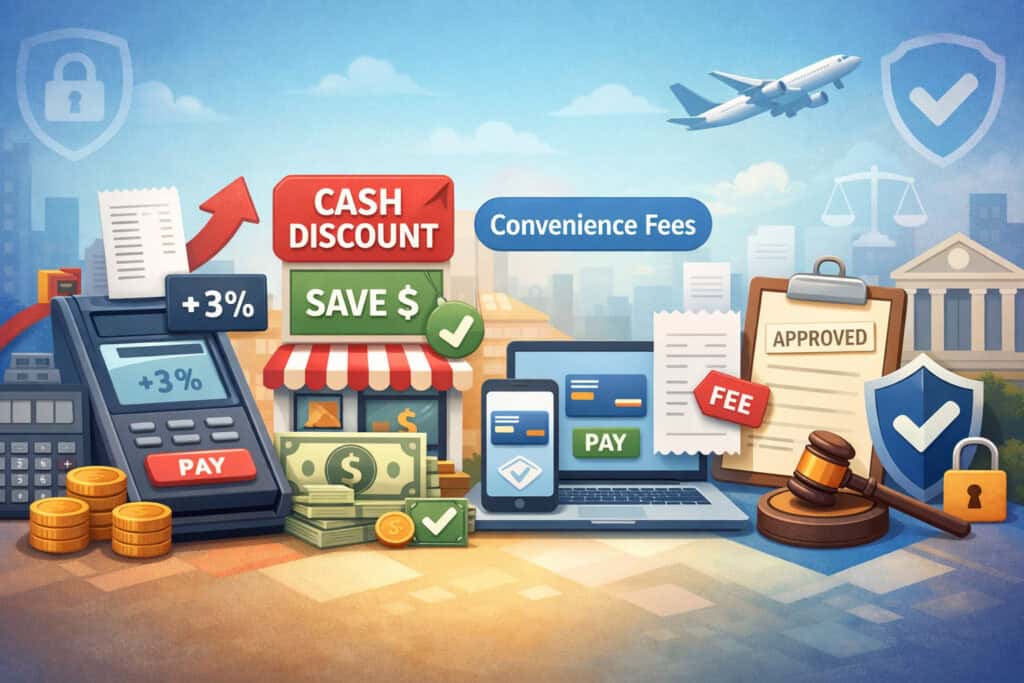
Many businesses try to offset acceptance costs through surcharging, cash discounting, or convenience fees. This can help margins, but cost transparency in merchant services must extend to customer-facing transparency too—clear disclosure, correct labeling, and policy consistency.
Surcharging rules can be complex because they depend on card brand rules and state-level restrictions. A compliant program generally requires proper signage and receipts that show the fee clearly, and it must follow network requirements.
Some guidance documents emphasize notice requirements and caps tied to network rules, and merchants should ensure their program meets both network standards and local requirements.
Cash discount programs are different from surcharging: the sticker price includes a built-in “cash price vs. card price” structure. If done properly, it can feel more customer-friendly, but it must be implemented carefully in POS configuration, signage, and receipt formatting.
Convenience fees are usually tied to a specific payment channel (for example, paying online vs. in person) and have their own rule framework.
Cost transparency in merchant services here means two things: (1) you understand exactly what your provider charges to run the program (set-up fees, program fees, compliance tools), and (2) your customers see fees clearly and consistently.
Hidden customer fees create reputational harm and higher disputes—costs that never show up as “processing” but hit your bottom line anyway.
Customer-Facing Disclosures: How Transparency Prevents Disputes
A major driver of chargebacks is “I didn’t recognize or agree to this.” Cost transparency in merchant services is not just a back-office finance issue; it’s an experience issue. When customers are surprised by fees, they complain, request refunds, and dispute charges.
Good disclosure reduces friction. That means clear signage at the point of decision, clear receipt formatting, and consistent labels (“service fee,” “surcharge,” “cash discount”) that match how you trained staff to explain it.
It also means your billing descriptor (what shows on the customer’s statement) should match your brand name and support contact method.
Transparent practices also align with the broader push against misleading fee presentation across industries. Even when a specific rule targets a particular sector, the direction of travel is toward clearer, upfront price communication.
When cost transparency in merchant services is paired with customer-facing transparency, you don’t just reduce fees—you reduce disputes, time spent on support, and reputational drag.
Network Rules and Operational Compliance That Merchants Overlook
Cost transparency in merchant services includes knowing the operating rules that can create fees or penalties. Card networks publish extensive merchant rules and compliance programs that govern acceptance, security, and dispute processes.
Operationally, transparency means you know what triggers compliance-related costs. Examples include failing to follow proper authorization procedures, not retaining receipts or proof of delivery for disputes, or using unsupported surcharging implementations.
It also includes data security responsibilities: storing card data improperly can create catastrophic costs far beyond standard processing fees.
The best approach is to treat compliance like prevention. Train staff on refunds and disputes, ensure your POS is configured correctly, keep documentation, and use fraud tools appropriate to your channel.
These decisions affect interchange outcomes, chargeback rates, and program fees. When you connect these dots, cost transparency in merchant services becomes a management system rather than a monthly surprise.
How to Compare Providers Without Getting Fooled
Provider comparison is where many merchants lose money, because sales proposals are optimized to look good on the surface. Cost transparency in merchant services requires comparing providers using your real transaction data, not generic promises.
Start by exporting a recent month of transaction detail: volume, number of transactions, average ticket, keyed vs. chip vs. tap, ecommerce volume, refunds, and chargebacks. Then request a true cost model from each provider. If they won’t model it or they insist on “qualified rates,” they may be avoiding transparency.
Compare these items specifically:
- Markup (basis points + per-item)
- Monthly platform/gateway fees
- PCI program and penalty structure
- Chargeback and retrieval fees
- Contract length, renewal, and termination fees
- Equipment costs (purchase vs. lease)
- Funding speed and payout fees
- Support quality and integration costs
Cost transparency in merchant services also means testing assumptions. If the provider promises a lower rate, ask: “Is that true for rewards cards, online cards, keyed cards, and business cards?” If the answer is vague, the transparency isn’t there.
Finally, insist on written documentation. A transparent provider can put it in writing: fee schedule, markup, and what can change. If the salesperson says “don’t worry about that,” worry about that.
The “Effective Rate” Trap and How to Calculate True All-In Cost
Effective rate is helpful, but it can be misleading if you don’t calculate it consistently. Cost transparency in merchant services means you compute true all-in cost using a standard method:
- Start with total processing-related fees for the month (variable + fixed).
- Decide how to treat equipment leases and POS subscriptions (include them if they are required to accept payments).
- Decide how to treat chargeback losses (at least track them separately).
- Divide by gross sales volume (or net settled volume, but be consistent).
Then look at the effective rate by channel. In-store and online behave differently. If your online effective rate is much higher, your opportunity may be fraud tools, AVS usage, or routing choices—not just negotiating markup.
Cost transparency in merchant services also means separating “processor cost” from “business cost.” Staff time handling disputes, checkout friction, and abandoned carts are real costs connected to payments. Transparent reporting helps you quantify them.
The goal is a cost model that predicts outcomes. If you can forecast next month’s costs within a small range based on projected volume and mix, you have cost transparency in merchant services that supports growth.
A Negotiation Checklist That Actually Works
Negotiation is easier when you’re transparent and specific. Cost transparency in merchant services gives you leverage because you can say, “This is the line item I want reduced or removed,” not “Can you lower my rate?”
Use this checklist:
- Ask for interchange-plus (or an equally auditable structure).
- Reduce basis points and per-item fees based on volume and ticket size.
- Remove monthly minimums if you’re stable volume.
- Eliminate junk account fees that don’t map to real services.
- Cap or eliminate annual fees, especially if you already pay platform fees.
- Confirm PCI fees: program cost vs. penalty cost, and remediation support.
- Get chargeback fees in writing and request reasonable terms.
- Avoid long equipment leases; negotiate purchase pricing or BYOD options.
- Ask for a change-notice policy: how you’re notified of fee changes.
- Request a quarterly business review with cost reporting.
Cost transparency in merchant services also improves when you ask for a sample statement that matches your contract language. If the provider can’t show you what billing will look like, you’re negotiating blind.
Remember: the best negotiation outcome is not only lower cost; it’s fewer surprises. Predictability is profit.
Building an Internal “Transparency System” for Ongoing Savings
Cost transparency in merchant services isn’t a one-time project. The best operators build a repeatable system: monthly reviews, KPI tracking, and policy updates tied to what the data says.
Start by tracking five KPIs:
- Effective rate (all-in)
- Card-present vs. card-not-present share
- Keyed entry rate
- Refund and chargeback rates
- Average ticket and authorization success rate
Then implement a monthly review workflow. Reconcile deposits, review top fee lines, and note changes. If a new fee appears, ask for the documentation and log it. Cost transparency in merchant services improves when you treat your processing relationship like a vendor contract with performance monitoring.
Operationally, set policies that reduce cost drivers: require chip/tap when available, restrict manual entry, train staff on clear receipts, and improve fraud screening online.
Align payment settings with your business model: subscriptions need strong descriptor management and clear cancellation policies; ecommerce needs strong address verification and delivery proof workflows.
Finally, document everything. A “payments binder” (digital folder) with your contract, fee schedule, PCI status, support contacts, and monthly statement notes is simple but powerful. It turns cost transparency in merchant services into institutional memory rather than tribal knowledge.
Reporting Tools, Dashboards, and What You Should Demand From Them
Many providers offer dashboards, but not all dashboards deliver transparency. Cost transparency in merchant services requires reporting that answers: “What changed, what caused it, and what do we do next?”
Demand these capabilities:
- Fee breakdown by category (interchange, assessments, markup, fixed fees)
- Transaction mix reporting (chip/tap/keyed/online)
- Card type analysis (debit vs. credit, rewards vs. non-rewards where available)
- Dispute lifecycle tracking with reason codes and outcomes
- Refund analytics and net revenue impact
- Exportable data (CSV) without extra charges
- User permissions and audit trails
If reporting is locked behind “premium analytics” fees, weigh the cost against the savings transparency enables. Often, improved decision-making pays for the tool. But the provider must be upfront. Cost transparency in merchant services means the reporting itself is priced transparently too.
A strong dashboard should reduce support calls. If you need to call to decode a fee every month, the data layer is failing. Transparency should be self-serve.
When to Bring in a Statement Audit and What to Watch For
Sometimes it’s worth hiring a third-party audit—especially if you process meaningful volume or suspect heavy fee creep. But cost transparency in merchant services still requires caution: auditors can oversell savings or push you into long contracts.
If you pursue an audit, insist on:
- A clear methodology (what fees they analyze and how)
- Written assumptions
- A neutral comparison of multiple providers
- Transparency on how they are paid (flat fee vs. shared savings vs. referral)
Watch for “savings” that come from changing your acceptance model in ways that impact customers, like aggressive surcharging implementations that increase disputes. The audit should consider total business impact, not just processor fees.
Done right, an audit can reveal hidden costs and contract misalignments. Done wrong, it swaps one opaque relationship for another. The goal remains the same: cost transparency in merchant services that you can maintain long-term.
Future Trends and Predictions for Transparent Merchant Pricing
Cost transparency in merchant services is moving from “nice to have” to “competitive necessity.” Several forces are pushing the market: merchant sophistication, software-driven commerce, and broader consumer and regulator expectations around upfront pricing.
One trend is better tooling for cost analytics. As reporting becomes more API-driven, merchants will demand transaction-level cost breakdowns, automated anomaly detection (flagging new fees), and forecasting. Providers who can’t provide transparent data will lose deals to those who can.
Another trend is ongoing pressure on opaque fee practices across industries. Even when specific rules apply to certain sectors, the overall direction is toward clearer fee disclosures and less bait-and-switch pricing, which shapes expectations merchants bring to merchant services contracts too.
We also expect more packaging innovation: subscription pricing, blended models for omnichannel businesses, and integrated payments bundled with POS software. These can be great—but only if cost transparency in merchant services remains intact. Bundles that hide payment margins inside software fees will face increased merchant pushback.
Finally, debit routing and interchange policy debates continue to influence cost structures for certain transactions, and merchants should anticipate periodic changes in network fee programs. Staying transparent means building that monthly review system so changes don’t become surprises.
What “Next-Gen Transparency” Could Look Like in 2–5 Years
The next phase of cost transparency in merchant services will likely be proactive, not reactive. Instead of reviewing statements after the fact, merchants will get real-time cost estimates per transaction type and alerts when costs deviate from baseline.
Expect features like:
- Real-time effective rate dashboards by channel
- “What-if” simulators (tap vs. keyed, wallet vs. manual entry)
- Automated contract compliance checks (flagging fees not in schedule)
- Chargeback risk predictions tied to product categories and policies
- Transparent settlement timelines with fee timing explanations
This kind of transparency also helps customer experience. If you can see the cost impact of a payment method, you can design checkout flows that balance conversion and cost. Cost transparency in merchant services becomes a product decision tool.
Merchants should also expect more standardized reporting formats, similar to how financial reporting norms develop over time. The winners will be providers that make costs legible—because legible costs earn trust, and trust reduces churn.
FAQs
Q.1: What is the biggest reason merchants lack cost transparency in merchant services?
Answer: The biggest reason is bundled or inconsistent billing—where underlying costs, provider markup, and add-on fees are mixed together under vague labels. Cost transparency in merchant services breaks down when you can’t separate what is pass-through (network/issuer related) from what is provider-controlled.
Another major cause is sales proposals that focus on a single “rate” while ignoring monthly fees, incidental charges, and exception pricing. Merchants then compare providers on the wrong metric.
A third reason is operational: when businesses don’t track acceptance methods (keyed vs. tap vs. online) and disputes, they can’t connect behavior to costs. The fix is to demand itemization, a complete fee schedule, and transaction-level reporting, then review it monthly so new fees don’t sneak in.
Q.2: Is interchange-plus always the most transparent option?
Answer: Interchange-plus is often the most transparent because it exposes markup clearly, but cost transparency in merchant services depends on implementation. A provider can still reduce transparency by adding extra “program” fees, marking up pass-through items, or using confusing labels on statements.
That said, interchange-plus makes it easier to benchmark because the provider’s profit is more visible, and you can audit categories and mix. Flat-rate and subscription plans can also be transparent if they provide a complete fee list and predictable rules.
The deciding factor is whether you can reconcile costs, predict effective rate changes, and identify what is controllable versus fixed. If you can do that, you have cost transparency in merchant services—regardless of model.
Q.3: How often should I review processing fees to maintain cost transparency in merchant services?
Answer: Monthly is the minimum. Cost transparency in merchant services erodes when you review only once or twice a year, because small fees accumulate and become “normal.” A monthly review should include: reconciling deposits, calculating effective rate, checking top fee lines, and scanning for new or renamed charges.
Quarterly, you should do a deeper dive: channel mix, dispute trends, refund behavior, and any contract updates. If your business is seasonal or growing fast, add a mid-month spot check during peak periods. The goal is simple: no surprises. Transparency is a habit, not an event.
Q.4: Can I improve cost transparency in merchant services without switching providers?
Answer: Yes, often. Start by requesting a complete fee schedule and asking support to map each statement line to the schedule. Ask for transaction-level exports and reports that separate interchange/assessments from markup.
Then optimize behaviors that raise cost: reduce keyed entry, improve online verification settings, train staff on refunds and receipts, and prevent duplicate charges.
You can also renegotiate specific fees—monthly minimums, platform fees, per-item charges—if you have stable volume. Even if you eventually switch, building transparency first makes switching safer because you know what you’re replacing and why.
Q.5: Do “free terminals” reduce costs or hurt cost transparency in merchant services?
Answer: They can hurt transparency. “Free” hardware is frequently paid for through higher markup, long-term contracts, non-cancellable leases, or inflated monthly fees.
Cost transparency in merchant services improves when equipment pricing is separate and explicit: purchase cost, warranty, replacement policy, and software fees. If you take a “free” offer, ask what you are committing to, how long, and what fees change if you leave. If the deal can’t be explained clearly in writing, it’s probably not transparent.
Q.6: How does cost transparency in merchant services relate to chargebacks?
Chargebacks are both a direct fee (per dispute) and an indirect cost (lost revenue, staff time, and higher risk scrutiny). Transparency means you can track disputes by reason, channel, and product/service type, and you know the exact per-item fees and timelines.
Better transparency also encourages prevention: clearer descriptors, better customer communication, proof-of-delivery workflows, and fraud tooling. When you treat disputes as a measurable cost center, cost transparency in merchant services becomes a driver of operational improvements—not just a finance discussion.
Conclusion
Cost transparency in merchant services is one of the simplest ways to protect margins without raising prices or cutting value. When you can identify every fee, separate base costs from provider markup, and track how operational choices affect outcomes, you stop being reactive.
You become intentional: you choose the right pricing model, negotiate the right levers, and build policies that reduce disputes and unnecessary costs.
The merchants who win are not the ones who chase the lowest advertised rate. They’re the ones who build a repeatable transparency system—clear contracts, auditable statements, monthly reviews, and data-driven optimization.
In a world that increasingly expects upfront clarity in pricing, cost transparency in merchant services will keep moving from “back-office detail” to “trust signal.” If your provider can’t explain your costs clearly, that’s already an answer.