By Michael Lanning March 19, 2026
A credit card dispute can feel like a routine admin issue at first. Then the notice arrives, funds are pulled, a response deadline appears, and suddenly your team is juggling evidence, customer records, and processing rules while trying to protect revenue.
That is why learning how to handle a Credit Card Dispute matters so much. A dispute is not just about one sale. It affects cash flow, staff time, chargeback fees, dispute ratios, account stability, and the trust customers place in your business. For merchants, good dispute handling is both a defense strategy and an operations discipline.
The good news is that Credit Card Dispute Resolution is manageable when you have a repeatable process. You do not need to guess, panic, or send a pile of random documents and hope for the best. You need a clear workflow, relevant evidence, and sound judgment about which cases are worth contesting.
This guide explains the full Credit Card Chargeback Process in practical terms. You will learn the difference between disputes, chargebacks, retrieval requests, and refunds. You will see how merchants should respond from first notice to final outcome.
You will also learn how to prevent repeat issues by improving customer communication, billing clarity, documentation, and internal controls.
If you want to handle Credit Card Disputes more confidently, reduce future losses, and build a stronger merchant dispute response system, this guide will give you a workable playbook.
What It Means to Handle a Credit Card Dispute
To handle a credit card dispute means responding to a cardholder challenge to a transaction in a structured, timely, and evidence-based way.
From the merchant side, it involves reviewing the claim, checking transaction records, gathering supporting documents, deciding whether to accept or contest the case, and submitting a response before the deadline.
Many merchants assume a dispute automatically means fraud. That is not always true. A cardholder dispute claim can come from several situations, including a confusing billing descriptor, a shipment delay, a duplicate transaction, dissatisfaction with a service, a misunderstanding about recurring billing, or true unauthorized use. The merchant’s job is to identify what actually happened and respond with the right documentation.
This is where Dispute Resolution for Merchants becomes different from customer service alone. Customer support may solve the problem early by issuing a refund or clarifying the purchase. But once a dispute enters the formal card network process, the focus shifts to records, deadlines, and compelling evidence.
Handling payment disputes well requires a mix of operational discipline and judgment. You need to know when to fight. You need to know when to accept the loss and fix the underlying issue instead.
You also need reliable access to invoices, signed receipts, proof of delivery, customer communication, refund policy acknowledgment, order confirmations, and processor data.
Dispute vs. Chargeback vs. Retrieval Request vs. Refund
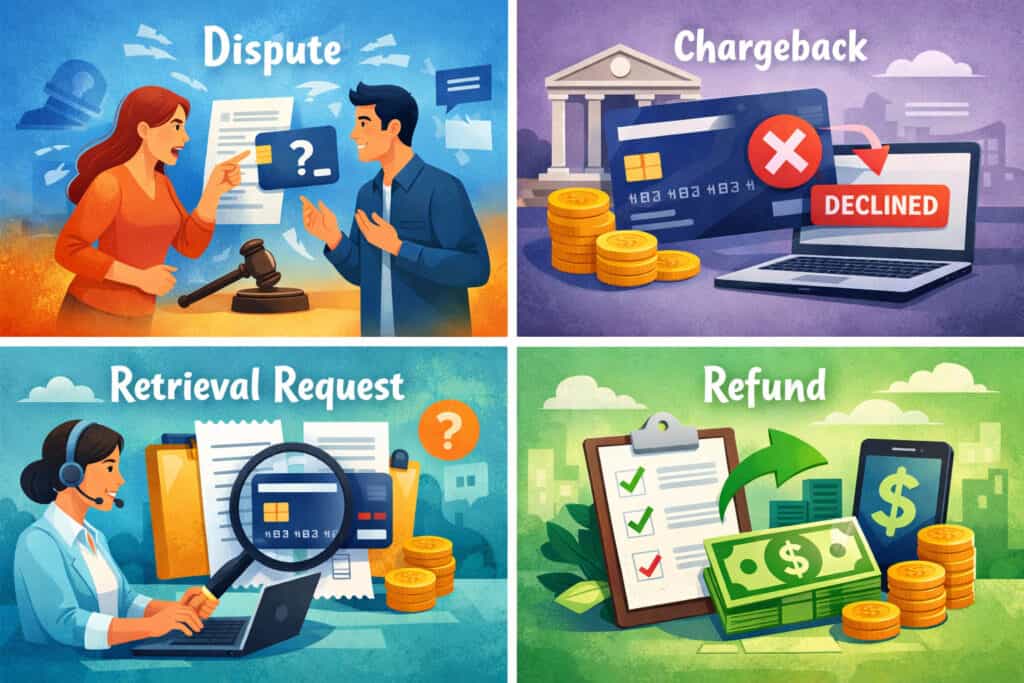
These terms are often used as if they mean the same thing. They do not. Understanding the difference helps you choose the right next step and avoid overreacting to the wrong type of notice.
What a dispute is and when it begins
A dispute starts when a cardholder questions a transaction with their card issuer or bank. The customer may say the charge was unauthorized, unclear, duplicated, not received, or not as described. In simple terms, the customer is asking the financial institution to review the charge.
From the merchant side, the dispute is the beginning of the problem, not necessarily the final outcome. Some disputes are resolved through early communication, supporting information, or pre-dispute tools before they become a full chargeback.
Others move quickly into a formal reversal process if the issuing side decides the claim has enough basis to proceed.
A dispute is best understood as the umbrella event. It is the complaint stage that can lead to several paths, including information requests, refunds, or chargebacks. That is why Handling Payment Disputes starts with reading the notice carefully instead of assuming every case is identical.
This stage is also where reason codes and initial case details matter. They help you understand whether the issue involves fraud disputes, merchant error, recurring billing confusion, or a customer expectation problem. The earlier you classify the issue correctly, the better your response.
What a chargeback is and why it hurts more
A chargeback is the formal reversal of the transaction after the dispute moves into the card network process. In practice, that means the disputed funds are taken from the merchant account, and the merchant may also be charged a dispute fee.
This is why the Credit Card Chargeback Process is more painful than a normal refund. With a refund, you control the outcome, timing, and customer communication. With a chargeback, the money is often removed first, and you must then fight to recover it through representation if you believe the claim is invalid.
Chargebacks carry a wider cost than the transaction amount alone. Merchants often lose the product, shipping cost, service time, original processing expense, internal labor, and the chargeback fee. Too many chargebacks can also damage your dispute win rate, raise processor scrutiny, and create risk for account stability.
Not every chargeback should be contested. But every chargeback should be reviewed. A disciplined review helps you determine whether the dispute resulted from fraud, friendly fraud, processing errors, or service gaps that need fixing.
What retrieval requests and refunds mean for merchants
A retrieval request is usually a request for transaction details before a full chargeback decision is made. It may ask for a receipt, invoice, proof of delivery, or other supporting records. Think of it as a warning signal and an opportunity. If you respond quickly and clearly, the case may stop there.
Retrieval requests matter because they reveal weak spots in your dispute documentation process. If your team struggles to find records fast, you are already at a disadvantage. Good dispute monitoring systems make it easy to locate the transaction, customer communication, refund terms, and delivery proof without digging through multiple systems.
A refund is different because it is a merchant-initiated return of funds. It can often resolve a customer complaint before it escalates. In many cases, a timely refund is cheaper than fighting a weak dispute.
That does not mean you should refund every complaint. It means you should understand the cost of each path. If the case is clearly your error, a refund can protect customer trust and reduce chargeback risk. If the customer received what they paid for and the claim is false, representation may be the better choice.
How the Credit Card Chargeback Process Works Step by Step
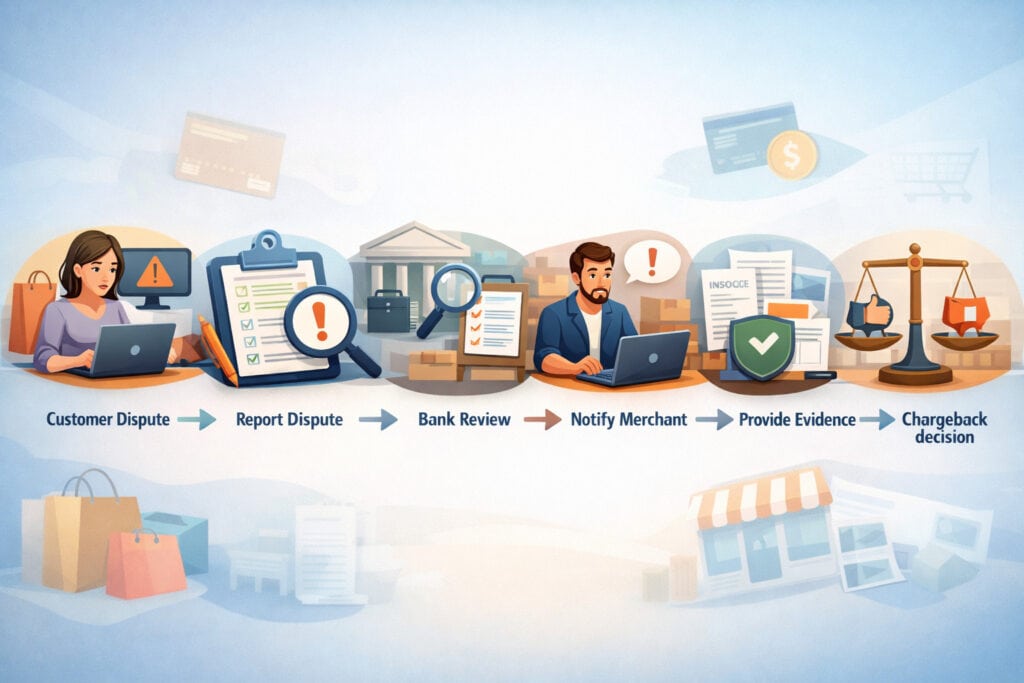
The Credit Card Chargeback Process can look complicated from the outside, but it becomes easier when you break it into stages. Merchants that know each stage can respond faster, submit better evidence, and avoid preventable losses.
Stage one: the complaint, review, and notification cycle
The process usually begins when the cardholder contacts their issuer and challenges a transaction. The issuer reviews the claim, assigns a dispute reason, and decides whether to open a case. If the case proceeds, the merchant is notified through the payment processor, acquiring side, or merchant portal.
This first notice is one of the most important documents in Credit Card Dispute Resolution. It usually includes the transaction details, reason code, amount, and response deadline. Do not skim it. Read it carefully. The exact wording often tells you what kind of evidence the issuer expects to see.
At this point, many merchants make their first major mistake. They rush to defend themselves before they fully understand the issue. A duplicate charge case requires different evidence than a product-not-received claim.
A recurring billing complaint requires different evidence than a fraud dispute. The better you classify the dispute at the start, the stronger your response will be.
It is also important to pull all related records immediately. That includes the order record, invoice, signed receipt if available, payment authorization data, customer messages, shipping details, refund policy, cancellation terms, and any service logs tied to the transaction.
Stage two: representment, review, and final outcome
If you decide to contest the case, you enter the representation process. Representment is the formal merchant response that explains why the transaction was valid and why the chargeback should be reversed. This is where compelling evidence matters.
A strong representation package is organized, relevant, and tied directly to the reason code. It does not overwhelm the reviewer with unrelated files. Instead, it tells a clear story supported by records.
If the case is about fraud, include authentication and transaction data. If the case is about delivery, include proof of delivery and customer communication. If the case is about cancellation, include the policy acknowledgment and service timeline.
After submission, the issuer reviews the merchant dispute response and decides whether to uphold or reverse the chargeback. Some cases end there. Others may move to additional review or arbitration, depending on the network rules and the strength of each side’s evidence.
Here is a simple view of the process:
| Stage | What Happens | Merchant Priority |
| Customer complaint | Cardholder challenges a charge | Identify the true issue fast |
| Dispute notice | Merchant receives reason code and deadline | Read details and preserve records |
| Internal review | Merchant decides whether to fight or accept | Measure win odds and cost |
| Representment | Merchant submits compelling evidence | Match evidence to reason code |
| Issuer review | Issuer evaluates both sides | Monitor status and respond if needed |
| Final outcome | Chargeback stands or funds return | Record lessons and improve prevention |
How Merchants Should Respond the Moment a Dispute Notice Arrives

The first hours after a dispute notice often determine whether a merchant can build a solid case or not. Fast action matters, but random action does not help. You need a disciplined sequence.
Start by confirming the basics. Check the transaction amount, transaction date, customer name, order number, and dispute reason code. Make sure you are looking at the correct sale. Then confirm the merchant response deadline and any formatting rules required by your payment processor support team or dispute portal.
Next, gather the internal facts before contacting the customer. Pull the order record. Review the billing and shipping information. Check whether AVS or CVV matched.
Look at the service records, refund requests, cancellation attempts, and support messages. See whether a refund was already issued, a package was delivered, or the customer complained about something before going to the issuer.
This internal review helps you decide whether the case is winnable. If your business made an obvious error, contesting the chargeback may waste time and money. If the charge is clearly valid and the claim appears false or misleading, you may have a strong representation case.
This is also where Dispute Resolution for Merchants becomes a business decision, not only a technical process. You are weighing evidence strength, dispute fees, staff time, and long-term chargeback prevention goals.
A good first-response checklist includes:
- Read the dispute notice line by line
- Confirm the merchant response deadline
- Identify the reason code and dispute category
- Pull transaction records and order details
- Review customer communication
- Check delivery, refund, or cancellation history
- Decide whether to accept or fight
- Assign one owner for the response package
If your business relies on several systems, centralization matters. Order data in one platform, shipping data in another, and customer service notes in a third will slow you down. A better workflow creates a single dispute documentation file for each case.
How to Read Reason Codes and Decide Whether to Fight or Accept
Reason codes can feel technical, but they are really just labels that explain why the dispute was filed. For merchants, they are the roadmap for building the right response.
A reason code tells you what the issuer believes happened. Common categories include fraud disputes, duplicate processing, paid by other means, merchandise or service not received, not as described, recurring transaction issues, credit not processed, and processing errors. Each category points to a different evidence strategy.
When the dispute is worth contesting
A dispute is usually worth contesting when the transaction was legitimate, your documentation is strong, and the expected recovery justifies the effort. This often applies in cases involving friendly fraud, customer confusion, or false claims about non-delivery when you have clear proof of delivery.
For example, if you have a signed receipt from a card-present sale, or proof of delivery and customer communication confirming receipt for an online order, your odds may be good. If a subscription customer agreed to recurring terms, received reminder notices, and used the service after billing, you may also have a persuasive case.
Contesting the dispute can also make sense when the issue exposes a broader fraud pattern. If the same customer has filed multiple weak claims, or similar dispute reason codes keep appearing against valid transactions, fighting those cases helps you protect future revenue and detect friendly fraud behavior.
That said, even strong cases need efficient packaging. Winning is not just about having good evidence. It is about presenting it in the right order with a clear explanation.
When accepting the dispute is the smarter move
Sometimes the correct move is to accept the chargeback, document the loss, and fix the underlying problem. This is often true when the merchant made a clear fulfillment mistake, billed incorrectly, failed to cancel on time, or cannot produce the documents needed to support the sale.
Weak evidence is a major warning sign. If you cannot show proof of delivery, service completion, policy acceptance, or clear transaction authorization, representation may not be worth the effort. The same is true for small-dollar disputes where the labor cost of fighting the case exceeds the likely recovery.
Accepting a dispute does not mean ignoring it. It means using it as a risk management signal. Track why it happened. Was the billing descriptor unclear? Did your staff skip documentation? Did your cancellation policy confuse the customer? Did a duplicate batch create a processing error?
What Compelling Evidence Looks Like in Real Merchant Cases
Compelling evidence is not a stack of random files. It is the specific proof that directly answers the issuer’s question under the dispute reason. Strong evidence is relevant, readable, and connected to the story of the transaction.
A merchant wins more often when the reviewer can understand the case quickly. That means labeling documents, explaining the timeline, and presenting the strongest items first.
Evidence for fraud claims and unauthorized transaction disputes
Fraud disputes are among the most common and frustrating cases because the cardholder is claiming they did not authorize the purchase. To challenge that claim, merchants need to show transaction legitimacy and customer connection to the order.
Useful payment dispute evidence can include:
- AVS and CVV match results
- IP address and device information
- Order confirmation records
- Login history or account access records
- Proof that the cardholder used the same account before
- Delivery confirmation linked to the billing or customer identity
- Customer emails acknowledging the order
- Digital service usage logs
- Signed receipt for card-present transactions
For phone orders or manually keyed payments, documentation becomes even more important. You may need call logs, verbal authorization notes, invoice records, service details, and internal verification steps that show the sale was not random or suspicious.
Friendly fraud cases often sit inside the fraud category. The customer may recognize the purchase but dispute it anyway. In those situations, prior order history, repeated use, matching contact details, and post-purchase communication can be very persuasive.
Evidence for delivery, service, duplicate, and billing disputes
When the claim is product not received, service dissatisfaction, duplicate charge, or recurring billing confusion, the evidence set changes. For delivery disputes, proof of delivery is critical. For service disputes, service records and communication history matter more.
Helpful evidence may include:
- Tracking history and delivery confirmation
- Signature confirmation or pickup records
- Installation logs or service completion notes
- Item descriptions and product images
- Invoices and order summaries
- Refund policy acknowledgment
- Cancellation policy acceptance
- Recurring billing disclosure
- Customer support emails or chat transcripts
- Proof that a credit was already issued
- Batch records showing one valid charge instead of two
Below is a practical evidence table merchants can use:
| Common dispute reason | Evidence that helps | When contesting may make sense | When accepting may make more sense |
| Fraud or unauthorized charge | AVS/CVV, IP data, device data, signed receipt, prior order history, usage logs | You can clearly connect the cardholder to the sale | Documentation is weak or identity link is unclear |
| Duplicate charge | Batch records, receipt, invoice, settlement records | Only one valid transaction exists | You truly processed the sale twice |
| Product not received | Tracking, proof of delivery, signature, pickup logs, customer messages | Delivery can be shown clearly | Shipment failed or cannot be proven |
| Not as described | Product page, service agreement, photos, usage records, support history | Offer matched what was sold | Product or service fell short materially |
| Recurring billing issue | Recurring terms, consent records, reminder notices, cancellation logs | Terms were accepted and cancellation was not completed | Billing continued after valid cancellation |
| Processing error or credit not issued | Refund record, terminal logs, settlement data | You can show the transaction or refund path clearly | Merchant records confirm a real error |
How to Handle Common Dispute Types Without Guesswork
To handle Credit Card Disputes effectively, merchants need category-specific playbooks. The reason is simple: not all disputes fail for the same reason, and not all disputes are won with the same evidence.
Fraud claims, friendly fraud, and unauthorized use
Fraud claims usually fall into two buckets. The first is true unauthorized use, where the genuine cardholder likely did not make the purchase. The second is friendly fraud, where the cardholder did make or benefit from the purchase but later disputes it.
In true fraud cases, accepting the chargeback may be the best choice if your records do not show strong customer connection. But you should still perform an internal review. Check whether your fraud screening failed, whether staff bypassed verification steps, or whether a high-risk order pattern slipped through.
In friendly fraud cases, merchants often have a better chance. Look for matching order history, repeat customer behavior, account login activity, customer communication after delivery, or evidence that the product was used.
For service businesses, session logs, project milestones, call notes, or signed work approvals can strengthen the response.
The key is avoiding generic rebuttals. If the issuer sees only a payment receipt without context, the case often feels weak. If the issuer sees a clean timeline showing purchase, confirmation, delivery, and usage, the case becomes much more credible.
Duplicate charges, non-delivery, dissatisfaction, and recurring billing confusion
Duplicate charge disputes often come from terminal issues, staff error, or customers misreading their statements. Review batch records, timestamps, and settlement data carefully. Sometimes what looks like a duplicate is actually an authorization and a settled sale, or two separate purchases. If it is truly duplicated, issue or document the refund fast.
For product-not-received disputes, proof of delivery is the center of the case. If you have tracking and signature confirmation, contesting may be worthwhile. If the shipment was delayed, lost, or delivered without clear proof, your case becomes weaker.
Service dissatisfaction cases can be more complicated. A customer may claim they did not receive what was promised, even after the work was completed. Here, contracts, scopes of work, service records, approval emails, and before-and-after documentation matter. For high-ticket transactions, keep detailed notes because the dispute amount may justify a full evidence package.
Recurring billing confusion is one of the biggest causes of avoidable disputes. Customers forget they enrolled, do not recognize the descriptor, or think cancellation was completed when it was not. Merchants need clear recurring billing consent, reminder messaging, accessible cancellation steps, and records showing exactly what the customer agreed to.
Practical Examples by Business Type
Dispute handling should reflect how the sale happened. A retail store, eCommerce seller, service provider, subscription business, and phone-order team all face different documentation needs.
For retail, signed receipts, POS records, chip-read confirmation, and surveillance or pickup records can be useful. A card-present sale with a verified receipt is usually stronger than a keyed transaction with limited documentation.
For eCommerce, order confirmations, AVS/CVV results, IP data, delivery scans, customer emails, and product page descriptions carry more weight. Online merchants should also keep records of checkout acceptance, refund terms, and post-purchase communication because card-not-present sales face more friction in disputes.
Service businesses need service records, schedules, work completion notes, contracts, approval emails, and customer acknowledgments. If you repair, install, consult, or perform scheduled work, your dispute file should show what was delivered, when it was delivered, and how the customer accepted it.
Subscription businesses must be especially strong on recurring billing disclosure. Save the signup flow, terms acceptance, renewal messaging, cancellation path, and account usage logs. If a subscriber used the service after billing, that can matter in the representment process.
Phone orders sit in a riskier category because they often lack the same automated data as online checkouts. These businesses need stronger manual records, such as call logs, employee notes, authorization steps, customer contact details, and proof the order was fulfilled.
High-ticket transactions deserve enhanced documentation regardless of channel. Use signature confirmation, ID checks where appropriate, detailed invoices, photos, serial numbers, milestone approvals, or delivery appointment logs. The larger the ticket, the less room you have for weak recordkeeping.
A useful prevention habit is reviewing your merchant operations beyond disputes alone. Merchant Cost Club’s article on best practices for reducing chargebacks emphasizes clearer descriptors, stronger fulfillment documentation, refund clarity, and better recurring billing controls, all of which align closely with lower dispute risk.
For a broader merchant-side overview of the dispute flow and representation, this guide to chargebacks for merchants from Host Merchant Services offers additional context on how disputes move from complaint to final decision.
How Handling Payment Disputes Affects Revenue, Risk, and Customer Trust
Merchants sometimes focus only on the disputed amount. That is understandable, but incomplete. Handling Payment Disputes affects much more than one transaction.
The most obvious impact is revenue loss. A chargeback can reverse the sale, remove cash from your account, and leave you with lost inventory or completed labor. You may also pay chargeback fees and spend staff time building a response package.
Then there is ratio risk. If disputes pile up, your dispute ratio can rise high enough to trigger more scrutiny from your processor or acquiring side. That can lead to account pressure, reserve discussions, pricing concerns, or limitations that make operating harder.
The operational cost is often underestimated. Every dispute creates work across customer service, accounting, fulfillment, and management. If your team is constantly hunting for transaction records, the hidden labor cost becomes significant.
But there is also a customer trust angle. Some disputes happen because customers cannot recognize your billing descriptor, cannot reach support, or do not understand the refund policy. In those cases, dispute prevention is really a customer experience improvement project.
Strong merchant risk management means you do both: you defend valid sales and fix the business conditions that create confusion. That may include:
- Cleaner billing descriptors
- Faster complaint handling
- Better proof of delivery practices
- Stronger service documentation
- Easier cancellation flows
- Consistent refund communication
- Better dispute monitoring dashboards
Common Mistakes Merchants Make During Credit Card Dispute Resolution
Many chargebacks are lost before the issuer even reviews the case fully. The loss happens because the merchant response is late, incomplete, misaligned to the reason code, or poorly documented.
One of the biggest mistakes is missing merchant response deadlines. Even a strong case can fail if the submission is late. Build internal buffers so your team is not sending evidence at the last possible moment.
Another common mistake is sending weak or irrelevant evidence. A receipt alone may not answer a non-delivery claim. A tracking number alone may not answer a recurring billing complaint. Reviewers need case-specific evidence, not generic attachments.
Merchants also lose cases by ignoring friendly fraud patterns. If repeat customers are disputing valid charges, and your team keeps treating those cases as random one-offs, you miss valuable signals. Track repeat cardholder dispute claims, shared emails, repeated reason codes, and dispute clusters by product or channel.
Billing descriptor issues are another frequent cause of preventable disputes. Customers often dispute charges they do not recognize even when the purchase was valid. A clear descriptor that matches your brand and support number can reduce those claims.
Documentation failures are everywhere. Staff may not log customer calls. Fulfillment teams may skip signature confirmation on expensive deliveries. Service teams may complete work without customer signoff. Each of those habits weakens future representation.
A final mistake is fighting everything. That wastes time and can distract from better prevention work. Dispute resolution for merchants should be selective, evidence-driven, and tied to business outcomes.
A Step-by-Step Merchant Checklist for Responding to Disputes and Reducing Future Chargebacks
A checklist helps turn dispute handling into a repeatable process instead of a scramble. This is especially helpful for growing businesses where several team members may touch the same case.
Response checklist for an active dispute
Use this checklist as soon as a case is opened:
| Task | Why it matters | Complete |
| Review dispute notice and reason code | Defines the evidence strategy | □ |
| Note the response deadline | Prevents automatic loss | □ |
| Pull transaction records | Confirms what happened | □ |
| Review customer communication | Reveals prior complaints or acknowledgments | □ |
| Check refund, cancellation, and delivery status | Identifies merchant error or defense points | □ |
| Decide whether to accept or contest | Saves labor on weak cases | □ |
| Build evidence file in a logical order | Improves reviewer clarity | □ |
| Submit before deadline | Keeps the case alive | □ |
| Track final outcome and reason | Supports dispute monitoring | □ |
| Log lessons for prevention | Reduces repeat chargebacks | □ |
When submitting the case, include a short narrative. State what the customer bought, how the transaction was authorized, how the goods or services were delivered, and why the dispute is invalid based on the reason code. Then attach the proof in labeled order.
Prevention checklist for lowering future chargeback risk
Use this checklist to reduce future disputes:
- Make your billing descriptor recognizable
- Send clear order confirmations and receipts
- Publish refund and cancellation terms clearly
- Require better documentation on high-risk orders
- Keep signed receipts and proof of delivery
- Log service completion and customer approvals
- Save recurring billing consent records
- Monitor dispute reason codes monthly
- Train staff on duplicate charge prevention
- Escalate unresolved complaints before they reach the issuer
- Work with payment processor support when patterns emerge
- Audit statements and processing workflows for friction points
This is also where merchants benefit from reviewing broader payment operations. Merchant Cost Club positions itself around lower-cost, more transparent merchant services and publishes operational resources focused on fee visibility and chargeback reduction.
Those themes are directly relevant to merchants trying to strengthen dispute response and long-term risk control.
Building a Long-Term Chargeback Prevention System
The best merchants do not just react to disputes. They build a system that reduces how often disputes happen, improves evidence quality, and makes representment easier.
Start with documentation standards. Every transaction should create a trail. That includes order details, payment authorization, product or service records, customer communication, refund actions, and delivery proof where relevant. When records are scattered, cases become harder to defend.
Next, improve customer communication. Send recognizable receipts. Make renewal notices easy to read. Confirm cancellations. Provide tracking quickly. Many disputes happen because the customer feels ignored or confused, not because the sale was truly invalid.
Then review operational weak spots. Are staff manually keying too many transactions? Are duplicate charges happening during busy periods? Are high-ticket deliveries going out without signatures? Are support complaints going unanswered for too long? Those patterns matter.
Dispute monitoring should also become part of your monthly review. Track chargebacks by reason code, channel, product category, staff location, and ticket size. That helps you identify whether your main problem is fraud, merchant error, recurring billing confusion, or fulfillment breakdown.
Finally, create accountability. One owner should manage the dispute process, but prevention should involve operations, customer service, finance, and sales. Chargeback prevention works best when the business treats it as a shared performance metric.
What is the first thing a merchant should do after receiving a dispute notice?
How is a refund different from a chargeback?
What is representment in the chargeback process?
What counts as compelling evidence in a merchant dispute response?
Should merchants fight every chargeback?
How can merchants reduce future chargebacks?
What causes friendly fraud?
Why do missed deadlines matter so much in credit card dispute resolution?
Conclusion
Learning how to Handle a Credit Card Dispute is no longer optional for merchants that want to protect revenue and keep payment operations healthy. A strong response process helps you recover valid sales, lower unnecessary losses, and avoid the chaos that comes from last-minute evidence gathering.
The most effective approach is simple in concept, even if it takes discipline in practice. Understand the dispute type. Read the reason code carefully. Gather relevant evidence. Meet the deadline. Decide whether to contest or accept based on proof, not emotion. Then use the outcome to improve future prevention.
Good Credit Card Dispute Resolution is not just about representation. It is about building cleaner records, clearer policies, better customer communication, and stronger merchant risk management across your business.
Merchants that handle disputes well tend to do three things better than everyone else. They document consistently. They respond quickly. And they learn from every case.
If you build those habits, you will not just handle Credit Card Disputes more effectively. You will reduce chargeback risk, improve customer trust, and create a more resilient payment operation overall.