Choosing a payment processor can feel simple until you start comparing the pricing. That is when many business owners realize they are not really choosing a processor first. They are choosing a pricing model.
That difference matters more than most sales pitches suggest. Two providers can both promise competitive credit card processing costs, but one pricing structure may quietly cost far more once your real transaction mix hits the statement.
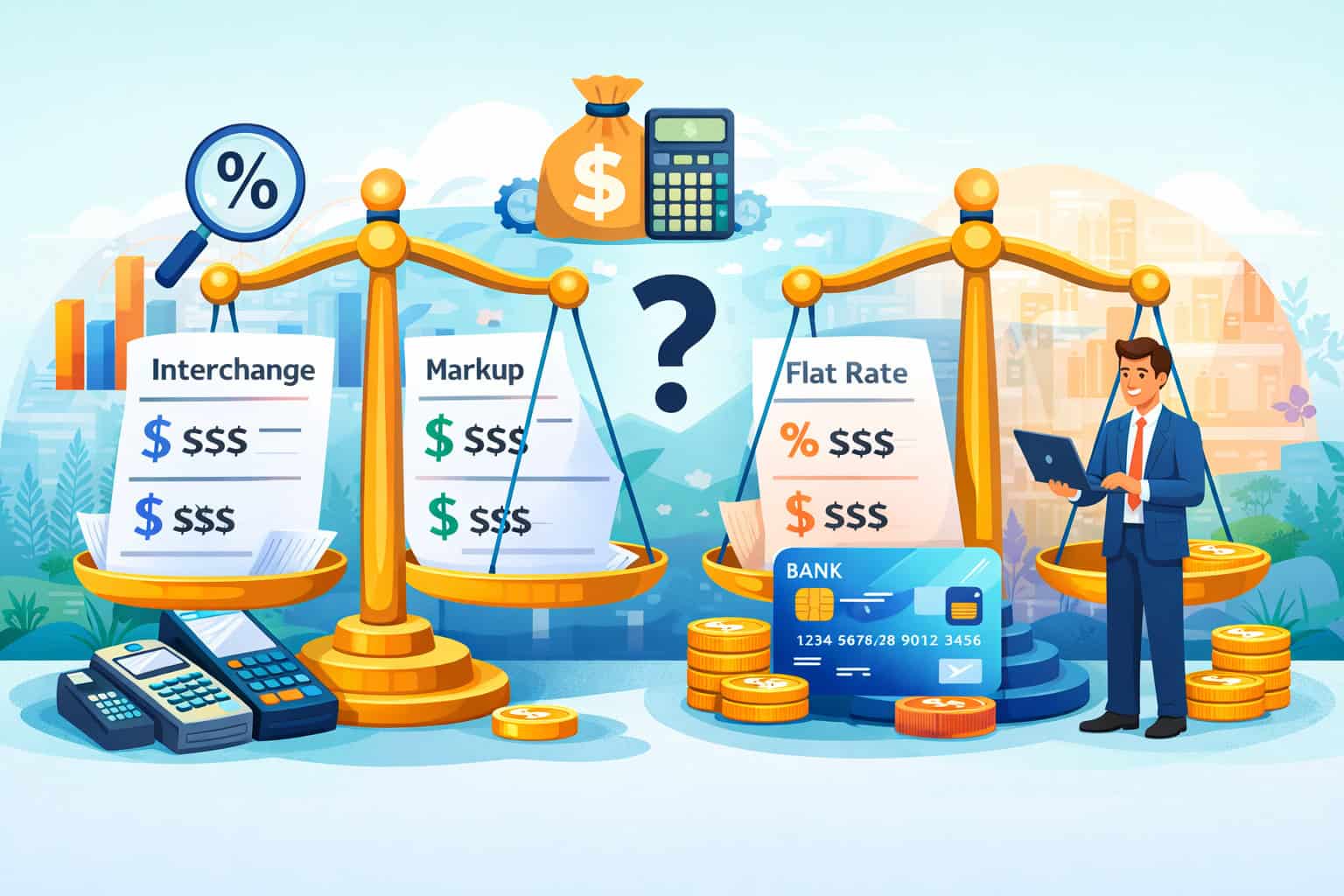
When people search for Interchange Plus vs Flat Rate Pricing, they usually want one answer: which option saves more money without creating new headaches?
The honest answer is that it depends on how your business processes payments, what types of cards your customers use, how large your tickets are, and whether you value simplicity more than long-term cost control.
Still, there are clear patterns. Flat-rate merchant pricing often wins on ease and predictability. Interchange-plus merchant pricing often wins on pricing transparency and total savings, especially once a business has steady volume or wants a closer look at where fees come from.
This guide breaks down both models in practical terms, not just industry jargon. You will learn how interchange fees work, what processor markup really means, how monthly fees and per-transaction fees affect your total bill, and how to compare real costs using your effective rate instead of just advertised pricing.
You will also see examples for retail, eCommerce, recurring billing, keyed-in payments, and multi-channel businesses.
By the end, you should be able to look at a processor quote, spot the real differences, and decide which model is more likely to reduce your merchant account fees over time.
Why This Pricing Comparison Matters More Than Most Merchants Realize
Payment processing pricing affects more than a few basis points on your statement. It shapes your margins, forecasting, pricing strategy, and even how confidently you can negotiate with providers.
Many merchants start by focusing on the advertised rate. That is understandable. A quote that says “simple flat fee” sounds easy to compare against a quote filled with interchange, markup, monthly fees, gateway fees, and PCI fees. But the advertised number is often only part of the story.
A pricing model determines whether you can see the true processing fee breakdown, whether lower-cost transactions actually save you money, and whether your processor can quietly increase profit without making it obvious. That is why a smart Merchant Pricing Models Comparison looks beyond the top-line number.
For smaller merchants, flat-rate pricing may reduce confusion and speed up setup. For established businesses, interchange-plus merchant pricing may uncover meaningful savings month after month. The larger the volume, the more those differences tend to matter.
There is also a strategy issue. If you do not understand your merchant account pricing structure, you may not notice when:
- your processor markup is wider than expected
- your monthly account fees erase any advertised rate advantage
- your card-not-present fees are dragging up your effective rate
- a gateway fee, PCI fee, or batch fee is making your “simple” plan less simple
- contract terms make it expensive to switch later
The goal is not just to pick a processor. It is to pick a pricing model that fits how your business actually accepts payments.
The real question is not “Which rate looks lower?”
The better question is, “Which pricing model gives my business the lowest total cost for the way I process payments?”
That includes much more than the sales quote. You need to consider:
- card-present fees versus card-not-present fees
- average ticket size
- monthly volume
- debit versus rewards card mix
- keyed-in versus swiped or tapped transactions
- recurring billing patterns
- refunds, chargebacks, and gateway use
- monthly fees and annual compliance-style charges
- processor contract terms
A processor can advertise a low rate and still be expensive if the quote hides markup or adds enough extra fees around the edges. Another processor may look more complex up front, yet end up cheaper once you review full statements side by side.
This is why businesses that grow beyond early startup volume often move away from purely convenience-based pricing and start caring more about transparency, effective rate, and total merchant savings.
Why business owners often overpay without noticing
Payment processing is full of small charges that feel harmless on their own. A few cents here, a small percentage there, a monthly fee that seems minor, and a gateway line item that gets ignored. But across hundreds or thousands of transactions, those costs add up quickly.
Overpaying often happens because merchants:
- compare offers using only the headline rate
- do not separate interchange fees from processor markup
- accept vague pricing language
- never calculate their effective rate
- fail to review statements line by line
- assume flat-rate merchant pricing is always more expensive or always simpler
- assume interchange-plus merchant pricing is always cheaper without counting monthly fees
Interchange Plus Pricing Explained in Simple Business Terms

Interchange-plus pricing is often described as the most transparent payment processing pricing model. In practical terms, it means you pay the actual base cost of each transaction plus a clearly stated processor markup.
The “interchange” portion is the underlying fee tied to the transaction itself. That fee varies depending on factors such as card type, whether the payment is card present or card not present, how the transaction is submitted, and the business category. The processor does not set interchange. The processor passes it through.
The “plus” portion is the processor’s markup. This is the amount the provider adds for its service. It is usually shown as a percentage, a per-transaction fee, or both.
So instead of seeing one bundled rate, you see the true cost layers. That is what makes Interchange Plus Pricing Explained so important for merchants who want pricing transparency and better long-term cost control.
Providers that specialize in transparent pricing often present interchange-plus this way. For example, Host Merchant Services explains that its model passes through the published interchange and assessments at cost and adds a clearly disclosed markup, rather than packaging everything into a single flat price.
How interchange-plus pricing works on a real transaction
Imagine a transaction where the underlying interchange cost is lower because the payment is a standard in-person debit transaction. Under interchange-plus pricing, that lower base cost flows through to you. If your processor markup is fixed, you benefit from that lower transaction cost.
Now imagine the opposite. A keyed-in rewards card or a manually entered card-not-present transaction may carry a higher interchange cost. Under interchange-plus pricing, you will also see that higher cost flows through. The same markup still applies, but the total fee rises because the underlying transaction is more expensive to process.
That means your statement reflects reality more closely. Low-cost transactions cost less. High-cost transactions cost more.
This is one reason interchange-plus merchant pricing is often favored by businesses with:
- strong in-person volume
- a healthy mix of debit cards
- larger monthly processing totals
- a desire for detailed statement analysis
- enough stability to benefit from fee optimization
It also makes it easier to compare processors. If one provider quotes interchange plus 0.30% and 10 cents while another quotes interchange plus 0.50% and 15 cents, the difference in markup is visible.
What makes interchange-plus attractive for cost-conscious merchants
The biggest appeal is transparency. You can see where your money goes and whether the processor’s markup is reasonable.
Other benefits include:
- lower-cost transactions can actually stay lower cost
- easier processor comparison because markup is disclosed
- more room for merchant savings as volume increases
- better statement analysis and fee troubleshooting
- improved negotiating power
Interchange-plus can also align better with growing businesses. As your volume rises, even a small markup difference can translate into meaningful monthly savings.
That does not mean interchange-plus is perfect for every merchant. It can feel more complicated at first. Statements are usually more detailed, and monthly fees may apply. But for businesses that want control rather than just convenience, it is often the stronger model.
Flat Rate Pricing Explained in a Way That Matches Real Life

Flat-rate pricing bundles payment processing costs into a single predictable rate, usually with one fee for in-person transactions and another for online or keyed-in transactions. Instead of paying the actual interchange plus a separate markup, you pay one all-in rate set by the provider.
That simplicity is the reason many new businesses choose it. You do not need to learn the details of interchange categories, processor markup, or statement line items to estimate your credit card processing costs. Every qualifying transaction in the same channel is priced the same way.
In other words, Flat Rate Pricing Explained is less about transparency and more about convenience. The provider absorbs the variation behind the scenes and charges you a standardized price that is easy to understand.
That can be helpful when speed matters more than optimization. It can also reduce the intimidation factor for merchants who are still learning how merchant account fees work.
How flat-rate pricing works behind the scenes
With flat-rate merchant pricing, the processor still pays underlying interchange fees. Those costs do not disappear. They are simply included inside the rate you are charged.
That means some transactions become more profitable for the processor than others. If a transaction has a lower underlying cost than the flat rate, the processor keeps more margin. If a transaction has a higher underlying cost, the processor earns less on that one transaction.
From the merchant side, the benefit is predictability. You know that a transaction processed in a certain way will usually carry the same fee structure. This can make bookkeeping easier, especially for very small businesses or businesses with limited payment complexity.
Common reasons merchants choose flat-rate pricing include:
- faster onboarding
- easy math for forecasting
- fewer statement categories to decode
- low administrative burden
- comfort with all-in pricing
For businesses with lower volume, limited staffing, or a simple sales setup, those benefits can be worth paying a bit more.
Where flat-rate pricing can start costing more
The tradeoff is that a single bundled price often means you do not keep the benefit of lower-cost transactions. If your business accepts many standard debit or basic credit transactions, flat-rate pricing may price those payments higher than necessary.
It can also make comparisons harder in a different way. While the core rate looks simple, additional costs may still exist outside the advertised flat fee, such as:
- monthly software or account fees
- gateway fees
- chargeback fees
- PCI-related charges
- hardware or platform costs
- add-on reporting tools
Another issue is that the convenience of flat-rate pricing can discourage statement review. Merchants assume the quote is simple, so they stop asking deeper questions. That can lead to missed savings opportunities as the business grows.
Flat-rate pricing is not inherently bad. It is just not always the cheapest option.
Interchange Plus vs Flat Rate Pricing: The Core Differences That Affect Savings
When comparing Interchange Plus vs Flat Rate Pricing, the biggest differences come down to transparency, predictability, simplicity, and long-term cost control.
Both models can work. The real question is which one fits your processing habits and financial priorities.
Flat rate tends to win on ease. Interchange plus tends to win on visibility and optimization. If you want a quick answer, flat rate is often easier to start with, while interchange plus is often better for merchants who want to reduce total processing expense over time.
The difference becomes easier to understand when you compare how costs are built.
| Feature | Interchange Plus Pricing | Flat Rate Pricing |
| Pricing structure | Actual interchange fees plus disclosed processor markup | Bundled all-in rate set by provider |
| Transparency | High | Moderate to low |
| Predictability | Moderate | High |
| Simplicity | Moderate | High |
| Savings potential for lower-cost transactions | Strong | Limited |
| Statement detail | More detailed | Usually simpler |
| Best for growing volume | Often yes | Sometimes no |
| Easy to compare true markup | Yes | Not usually |
| Good for very small or early-stage merchants | Can be | Often yes |
| Long-term cost control | Strong | Mixed |
This pricing model comparison matters because the cheapest option depends on whether you value convenience or control more.
Transparency versus predictability
Interchange-plus merchant pricing gives you a clearer processing fee breakdown. You can see the base cost and the provider’s markup separately. That is useful for merchants who want to understand why costs rise or fall month to month.
Flat rate offers easier predictability. If you know your pricing by channel, you can estimate fees quickly without worrying about interchange variation. That is attractive for owners who want less complexity in day-to-day operations.
The challenge is that predictability does not always mean lower cost. In fact, you may be paying extra for the privilege of not seeing the underlying details.
If you are trying to lower merchant account fees, transparency is usually more valuable than convenience. If you are trying to launch quickly and keep operations simple, predictability may matter more in the short term.
Simplicity versus long-term control
Flat rate is simpler. There is no need to learn interchange categories to understand your base price. That makes it approachable for startups, side businesses, and merchants with limited internal finance support.
Interchange plus takes a little more effort to understand, but it gives you more control over long-term costs. It lets you separate unavoidable fees from negotiable fees. That distinction is powerful because it shows you what can actually be improved.
Under interchange plus, you can ask better questions:
- Is the processor markup fair?
- Are monthly fees too high?
- Are gateway fees reasonable?
- Are there hidden non-processing charges?
- Is my effective rate rising because of card mix or because of markup creep?
Under flat-rate merchant pricing, those questions are harder to answer because the cost structure is more bundled.
Where the Money Actually Goes: Breaking Down Common Merchant Account Fees

A lot of confusion around payment processing pricing comes from not knowing which fees are unavoidable and which fees come from the processor.
No matter which model you use, your total cost may include multiple layers. Understanding them helps you compare offers more accurately and avoid surprises after onboarding.
The most useful way to think about merchant account fees is to split them into transaction costs, account costs, and exception costs.
Transaction-level costs you will see most often
These are the charges tied directly to processing payments.
Interchange fees: These are the base transaction costs. They vary depending on card type, sales channel, and how the payment is processed.
Processor markup: This is what the provider adds for service. In interchange-plus merchant pricing, it is usually disclosed. In flat-rate merchant pricing, it is baked into the all-in rate.
Per-transaction fees: These are flat amounts charged on each sale. They matter more when you have many small-ticket transactions.
Card-present fees: These usually apply to payments accepted in person by dip, tap, or swipe and tend to be lower than manually entered or remote transactions.
Card-not-present fees: These apply to eCommerce, keyed-in, invoice, or virtual terminal payments and often cost more due to higher risk and different interchange treatment.
If you do a processing fee breakdown, these charges are usually the largest cost drivers.
Account-level and operational fees that can change the real deal
These charges may not appear in headline pricing but still affect total savings.
Monthly fees: These can include account fees, platform fees, reporting fees, software fees, or support-related charges.
Gateway fees: If you use an online payment gateway, there may be monthly gateway access fees or per-transaction gateway charges.
PCI fees: Some providers charge for PCI-related compliance programs, scanning, or administration. These can be modest or surprisingly expensive.
Batch fees: Certain processors charge a fee each time your terminal closes out the day’s transactions.
Chargeback fees: These apply when a chargeback is filed, regardless of whether you win the dispute later.
These items matter because one pricing model can look better on percentage alone while losing on total monthly cost.
Which Pricing Model Fits Different Business Types and Sales Channels?
A good Merchant Pricing Models Comparison is not just about rates. It is about fit. The same pricing structure can save one business money and cost another business more.
That is why business owners should compare pricing models against their actual operating profile. Monthly volume, average ticket size, card mix, and sales channels can change which model performs best.
Retail, in-person, and service-based businesses
Businesses with strong in-person sales often have a better chance of benefiting from interchange-plus merchant pricing. That is especially true if they process a healthy number of standard debit and regular credit card transactions.
Why? Because lower-cost card-present transactions can remain lower cost under interchange plus. With flat rate, those lower-cost opportunities are often bundled into a higher all-in fee.
Examples where interchange plus may fit well:
- retail stores with steady counter sales
- service businesses using tap, dip, or mobile terminal payments
- specialty stores with moderate to high monthly volume
- businesses with larger average tickets
That said, very small in-person merchants may still prefer flat rate if ease matters more than fee optimization. If you process limited monthly volume, the dollar difference may not justify a more detailed pricing structure.
eCommerce, keyed-in, recurring billing, and multi-channel merchants
Online and keyed-in businesses often face higher base transaction costs, which can narrow the savings gap between models. That does not automatically make flat rate better, but it does mean the comparison needs more care.
Businesses in these categories should pay close attention to:
- gateway fees
- virtual terminal charges
- fraud tools
- recurring billing platform fees
- card-not-present pricing
- chargeback fees
Interchange plus can still save money here, especially at higher volume, but the supporting fee structure matters more. A flat-rate plan may look competitive if it includes software and tools that would otherwise be add-ons elsewhere.
Multi-channel merchants need to be even more careful. If you sell in person and online, one channel may be lower cost and another much higher. Interchange-plus pricing can reveal these differences clearly, while flat rate may average them together.
Real-World Scenarios: When Interchange Plus Saves More and When Flat Rate Can Make Sense
Abstract pricing comparisons are useful, but real-world scenarios make the differences easier to see. The goal here is not to promise identical outcomes. It is to show how payment processing pricing behaves under different business patterns.
Scenario one: steady in-person retail with mid-sized tickets
Imagine a retail business processing a healthy monthly volume with most transactions completed in person. The average ticket is solid, the card mix includes plenty of debit, and the business batches consistently.
In this type of setup, interchange-plus merchant pricing often saves more. The reason is simple: many of the transactions may have relatively efficient underlying costs, and the merchant gets the benefit of those lower-cost transactions instead of paying one bundled rate.
This kind of merchant may also benefit from:
- lower effective rate over time
- clearer statement analysis
- easier negotiation of processor markup
- better insight into which cards or channels increase costs
A flat-rate plan may still work, but it often leaves savings on the table if a large share of transactions are already low cost.
Scenario two: low-volume startup or solo business with simple needs
Now imagine a smaller business that processes modest monthly volume, wants a fast setup, and values simplicity over fine-tuned optimization. Perhaps the owner is doing everything personally and does not want to decode detailed statements.
In that case, flat-rate merchant pricing may make sense, even if it is not always the absolute lowest-cost model. The convenience can be worth it when:
- monthly volume is still low
- time savings matter more than statement precision
- the owner wants predictable math
- operations are simple and channel count is limited
The key is to keep reevaluating. What works well at low volume can become less efficient as sales increase.
Scenario three: online business with recurring billing and higher-risk transaction patterns
An online business with subscriptions, card-on-file billing, and a higher share of manually reviewed or card-not-present transactions may not see the same dramatic savings from interchange plus that a strong in-person retailer sees.
Still, interchange plus can win if the processor markup is fair and gateway-related charges are reasonable. Flat rate may look attractive if it bundles useful tools and reduces administrative work.
This is where the best answer comes from a real statement analysis, not a theory.
How to Calculate Effective Rate and Compare Real Processing Costs
One of the most useful numbers in payment processor comparison is your effective rate. It helps you cut through marketing language and see what you are actually paying as a percentage of processed volume.
Your effective rate is calculated like this:
Total processing fees ÷ total card sales = effective rate
If your total card sales for a month are $50,000 and your total processing costs are $1,500, your effective rate is 3%.
This number matters because it captures more of your real expense than an advertised headline rate. It can include transaction fees, monthly fees, gateway fees, and other recurring costs that influence what you truly pay.
What effective rate tells you that advertised pricing does not
A quoted rate can be selective. It may refer only to a specific channel, card type, or base transaction class. Your effective rate reflects what happened in reality.
It helps answer practical questions like:
- What did processing actually cost me this month?
- Are my monthly fees changing the picture?
- Is my flat-rate plan really as simple as it sounds?
- Is my interchange-plus markup competitive in real terms?
- Are online or keyed-in transactions inflating my average cost?
Effective rate is especially useful when comparing providers because it puts everything into one understandable number. That does not replace detailed fee analysis, but it gives you a clear starting point.
How to use effective rate the right way
Effective rate works best when you compare similar months and similar transaction profiles. A month with unusually high online sales or large-ticket invoices may not be a fair comparison against a mostly in-person month.
To get a more reliable view:
- review at least two or three statements
- separate card-present and card-not-present volume where possible
- include all recurring processing-related charges
- note one-time fees separately
- compare providers using the same transaction mix assumptions
For a deeper review process, statement review resources and fee education from Merchant Cost Club can be useful, especially when you want to identify whether your pricing structure is the real issue or whether specific line items are driving the cost.
Common Mistakes Merchants Make When Comparing Payment Processors
Many merchants do the hard part by collecting quotes, then lose the comparison because they focus on the wrong details. Payment processor comparison is less about finding the lowest advertised number and more about understanding the whole pricing model.
Mistake one: focusing only on the headline rate
A flat rate that looks neat on a landing page can still be expensive once gateway fees, chargeback fees, or platform charges are added. An interchange-plus quote with a small markup can also disappoint if the monthly fees are excessive.
The headline rate is only useful when it sits inside full pricing context.
Mistake two: ignoring monthly and non-transaction fees
Some merchants fixate on percentage pricing and forget that recurring account charges can significantly change their total cost.
These may include:
- monthly account fees
- gateway fees
- PCI fees
- platform or software charges
- statement fees
- batch fees
A lower transaction rate does not guarantee lower total payment processing pricing.
Mistake three: failing to review contract terms
Processor contract terms can change the economics of a deal. Early termination language, rate increase clauses, auto-renewal terms, hardware commitments, and software lock-ins matter.
A strong pricing model on paper loses value if it becomes hard to leave later or if rates can rise quietly after onboarding.
Mistake four: not reviewing statements after setup
Some merchants compare carefully at the start, then never look again. That is risky. Fees can drift, line items can change, and small add-ons can appear over time.
Regular statement analysis protects merchant savings and helps catch issues early.
Pro Tip: A good processor should be able to explain your pricing model in a way that matches your statement. If the quote is easy to understand but the statement is not, that is a warning sign.
Red Flags to Watch for in Processor Offers and Sales Language
Not every pricing offer is deceptive, but vague language is common enough that merchants should stay alert. A strong offer should be understandable, documented, and easy to reconcile with your actual billing.
Vague pricing language and teaser-rate marketing
Be cautious when a processor uses broad claims without clear details, such as:
- rates “as low as”
- “simple pricing” without full fee disclosure
- “wholesale pricing” without defined markup
- “no hidden fees” but no actual schedule
- “custom quote” that avoids answering direct pricing questions
Teaser rates are especially risky because they may highlight only the most favorable transaction type while leaving out the rest of the fee picture.
Hard-to-read statements and hidden markups
A confusing statement is not just annoying. It can be profitable for the processor. When line items are unclear, merchants are less likely to challenge excessive charges or markup creep.
Watch for:
- bundled descriptions with little detail
- unexplained monthly charges
- duplicate-looking fees
- changing fee names from month to month
- statements that make effective rate hard to calculate
Transparent providers tend to make pricing easier to audit. For example, educational resources such as Host Merchant Services’ explanation of interchange-plus pricing highlight clearly disclosed markup as a key feature of transparent pricing.
Pressure tactics and incomplete fee schedules
A processor that wants you to sign before sharing the full fee schedule is creating unnecessary risk.
Be cautious if a rep:
- avoids discussing processor markup
- dismisses monthly fees as unimportant
- refuses to show contract terms in advance
- pushes urgency instead of clarity
- says statement analysis is unnecessary
A credible provider should welcome informed comparison.
A Step-by-Step Checklist to Estimate Which Model May Save More
The fastest way to determine whether Flat Rate vs Interchange Plus Pricing is better for your business is to use your own processing data. A structured checklist makes that easier.
Step one: gather real statements and current fee details
Pull at least two or three recent statements. You want a representative view, not a one-month outlier.
Collect:
- total monthly card volume
- total number of transactions
- average ticket size
- in-person versus online volume
- recurring billing volume
- manually entered payment share
- all monthly fees
- gateway and PCI-related charges
- chargeback fees, if any
This gives you a real baseline for comparison.
Step two: identify your transaction profile
Before comparing models, understand how your business processes payments.
Ask:
- Do most customers pay in person or online?
- Do I process many small tickets or fewer large tickets?
- Is my card mix heavy on debit or rewards cards?
- Do I use subscriptions, invoices, or card-on-file billing?
- Am I multi-channel?
This matters because different profiles perform differently under different pricing structures.
Step three: compare two full-cost quotes, not just rates
Request a flat-rate quote and an interchange-plus quote using your actual sales mix.
Make sure each quote includes:
- percentage fees
- per-transaction fees
- monthly fees
- gateway fees
- PCI fees
- batch fees
- chargeback fees
- any software or platform fees
Then estimate your monthly total under each model.
Step four: calculate the effective rate under each option
Once you estimate monthly totals, divide by projected card volume to compare effective rate.
This gives you a clear apples-to-apples number. It also helps expose whether a “simple” quote is actually more expensive than a more detailed one.
Step five: evaluate beyond price alone
Price matters, but so do support, statement clarity, contract terms, and ease of reconciliation.
Use this final checklist:
- Is the pricing model easy to understand?
- Can I identify the processor markup?
- Are monthly fees reasonable?
- Are contract terms fair?
- Will this still make sense as my volume grows?
- Can I review statements without guessing what charges mean?
How to Decide Between Interchange Plus and Flat Rate Without Overthinking It
At a practical level, this decision often comes down to the stage and structure of your business.
If you want the simplest possible pricing, process lower volume, and do not need detailed fee analysis, flat-rate merchant pricing can be perfectly reasonable. It is easy to understand and easy to budget around.
If you want greater pricing transparency, more control over your merchant account pricing structure, and better odds of lowering credit card processing costs over time, interchange-plus merchant pricing is usually the stronger choice.
Choose flat rate if these priorities sound like yours
Flat rate may fit better if:
- your monthly processing volume is still small
- you want quick setup and minimal complexity
- your business has a simple sales model
- you prefer predictable pricing by channel
- you are willing to pay somewhat more for convenience
This can be a useful stepping stone model. It is often best for businesses still establishing their payment habits.
Choose interchange plus if these priorities sound like yours
Interchange plus may fit better if:
- you have steady or growing monthly volume
- you want transparent pricing
- you care about long-term merchant savings
- you review statements regularly
- your business wants to negotiate markup intelligently
- you process enough in-person volume to benefit from lower-cost transactions
Many established merchants eventually move toward interchange plus because it gives them more insight and more control.
That does not mean every interchange-plus quote is good. You still need to examine markup, monthly fees, and contract terms carefully. But when the offer is clean and the markup is fair, interchange plus often provides stronger long-term value.
FAQ (Frequently Asked Questions)
What is the main difference between Interchange Plus vs Flat Rate Pricing?
The main difference is how the price is structured. Interchange-plus pricing passes through the actual interchange fees and adds a clearly disclosed processor markup. Flat-rate pricing bundles those costs into one all-in rate. Interchange plus offers more transparency, while flat rate offers more simplicity and predictability.
Is interchange-plus always cheaper than flat-rate pricing?
Not always. Interchange-plus often saves more for businesses with steady volume, strong in-person sales, or a favorable card mix. Flat-rate pricing may still make sense for lower-volume businesses that want convenience and predictable billing.
Why do many merchants prefer interchange-plus merchant pricing?
Many merchants prefer interchange-plus because it provides pricing transparency. It allows them to see the processor markup clearly, review statements in more detail, and understand how different transaction types affect their total processing cost.
When does flat-rate merchant pricing make the most sense?
Flat-rate pricing usually makes the most sense for smaller businesses, newer merchants, or businesses that want a very simple setup. It can be a good option when ease of use and predictable pricing matter more than detailed fee visibility.
What fees should I compare besides the transaction rate?
You should compare the full fee structure, including monthly fees, per-transaction fees, gateway fees, PCI fees, batch fees, chargeback fees, and any software or platform costs. These extra charges can make a big difference in your total processing expense.
How do I calculate my effective rate?
To calculate your effective rate, divide your total processing fees by your total card sales. This gives you a real-world percentage that shows what you actually paid, which is often more useful than looking only at advertised rates.
Can online businesses still benefit from interchange-plus pricing?
Yes. Online businesses can still benefit from interchange-plus pricing, especially at higher volume. However, they should compare gateway fees, fraud tools, recurring billing costs, and card-not-present fees carefully because those charges can affect the total savings.
What is a processor markup?
Processor markup is the portion of the fee that the payment processor keeps for providing its service. In interchange-plus pricing, it is usually shown separately. In flat-rate pricing, it is built into the bundled rate.
How often should I review my merchant statement?
You should review your merchant statement every month. Regular statement analysis helps you catch fee changes, new charges, or shifts in your transaction mix before they start costing your business more money.
What is the safest way to compare processors?
The safest way is to use your recent statements, request full fee schedules, estimate your total monthly cost under each model, calculate your effective rate, and review contract terms before signing. This gives you a more realistic comparison than relying on advertised rates alone.
Conclusion
The debate around Interchange Plus vs Flat Rate Pricing is really a debate about what your business values most: simplicity now or deeper cost control over time.
Flat-rate pricing is easier to understand and easier to forecast. It is often a practical fit for newer merchants, lower-volume businesses, and owners who want straightforward billing with minimal analysis.
Interchange-plus pricing is more detailed, but that detail is exactly what gives it power. It shows where costs come from, separates interchange fees from processor markup, and creates more room for meaningful savings as volume grows.
For many established merchants, it is the stronger long-term option because it rewards visibility and disciplined statement review.
The best decision is not based on a headline rate. It comes from your real sales mix, your average ticket, your card-present and card-not-present volume, your monthly account fees, and your willingness to monitor statements over time.
If your business is still small and wants convenience, flat rate can be a smart starting point. If your business wants pricing transparency, stronger negotiating leverage, and a clearer path to lower processing costs, interchange plus is often worth the extra attention.
In the end, the model that saves you more is the one that matches how you actually process payments, not the one with the most attractive sales pitch.